The energy industry is proving its readiness to act. Last month at Messe München, The smarter E Europe 2026 wrapped up with a clear message: The technological solutions for a reliable, 24/7 renewable energy supply are here and market-ready. As a co-organizer, Solar Promotion GmbH takes stock of market trends and the "Renewables 24/7" special exhibit.
Europe's largest exhibition alliance for the energy industry saw an incredible response. A total of over 2,650 exhibitors from 52 countries showcased their innovations across 19 fully booked exhibition halls and the outdoor area. The share of international companies exceeded 66 percent.
Around 105,000 trade visitors from 163 countries used the three exhibition days to gather information and network. Ahead of the main event, four preliminary specialist conferences and connected side events brought together more than 3,000 industry representatives for knowledge sharing. This level of participation highlights the immense need for cross-sector exchange.
The global market is growing faster than experts predicted. The latest "Global Market Outlook for Solar Power 2026–2030" recorded a worldwide addition of 664 gigawatts of new photovoltaic capacity in 2025. This brings the total installed capacity past the three-terawatt mark for the first time. In June 2025, photovoltaics temporarily covered over 22 percent of the EU's electricity demand.
This development is supported by the European battery storage market. In 2025, storage capacity surged past 100 gigawatt-hours thanks to an additional 36 gigawatt-hours (a 48 percent increase). For the first time, utility-scale storage made up the majority of new installations. Falling cell prices continue to drive this momentum over the long term.
"Fossil fuels are a thing of the past. We are proving with scientific data that renewable energy creates stability, resilience, and cost-efficiency. The battery era has begun, and we provide the right platforms for this transition." – Markus Elsässer, CEO of Solar Promotion GmbH
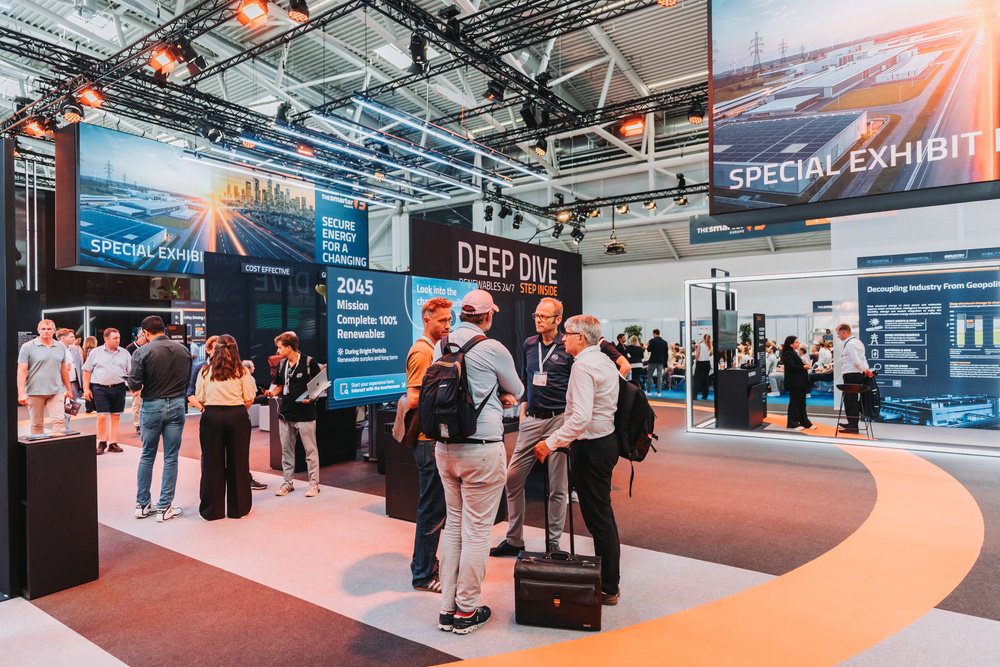
The center of attention was the special exhibit "Renewables 24/7 – Secure Energy for a Changing World." The scientific foundation was provided by the study "Cost-Optimal Transformation of the German Energy System by 2045" by the Fraunhofer Institute for Solar Energy Systems ISE. The special exhibit offered a hands-on demonstration of how Germany, as an industrialized nation, can fully transition to a carbon-neutral energy supply sourced entirely from renewables.
Industry experts debunked concerns regarding the so-called "Dunkelflaute" (periods of low wind and solar output). Since periods without sufficient wind and sunlight statistically account for only about one percent of the year, converting green hydrogen back into electricity secures power during these phases. The day-to-day balancing of the grid is handled by decentralized home storage systems, large-scale batteries, bidirectional EV charging, and smart demand-side management.
The relevance of the event was reflected in the strong political turnout. In her opening remarks, Rita Schwarzelühr-Sutter, Parliamentary State Secretary at the Federal Ministry for the Environment, highlighted the roughly 440,000 jobs in Germany’s renewable sector and its vital role in economic resilience. Bavarian Economics Minister Hubert Aiwanger opened the integrated Hydrogen Dialogue Summit. Additionally, Barbie Haller, Vice President of the Federal Network Agency (Bundesnetzagentur), engaged in discussions with industry representatives.
The special exhibit was supported by a coalition of industry associations, including the German Renewable Energy Federation (BEE), the German Solar Industry Association (BSW-Solar), the German Hydrogen Association (DWV), and the German Mechanical Engineering Industry Association (VDMA). Industrial giants such as CATL, Fenecon, GE Vernova, Octopus Energy, and Siemens joined as technology partners to showcase the corresponding system components.
The industry is already delivering the products required for a decentralized, digital, and flexible energy system powered by renewables. To sustain this pace of expansion, political frameworks must now adapt. Removing regulatory hurdles, accelerating grid expansion, and establishing incentives for grid-supportive behavior are the vital next steps.